How much protein do you need per day?
Daily protein targets for general health, weight loss and strength training, how to spread protein across meals, and easy sources including budget-friendly local foods.
By the Fitlyn editorial team · Published · 3 min read
Protein helps you keep and build muscle, stay full between meals and recover from training. It is also the nutrient people most often under-eat when they start cutting calories. Here is how to find a sensible target.
The minimum for general health
For healthy adults, the widely used recommended dietary allowance is 0.8 g of protein per kilogram of body weight per day. For a 70 kg adult, that is about 56 g a day.
This is the amount that prevents deficiency in most people. It is not necessarily the best amount if you are active, losing weight or getting older.
Higher targets for active people and weight loss
Sports nutrition research suggests that people who exercise regularly benefit from more:
| Situation | Typical daily target |
|---|---|
| General health, not very active | 0.8–1.0 g per kg |
| Regular exercise | 1.2–1.6 g per kg |
| Strength training to build muscle | 1.6–2.0 g per kg |
| Losing weight while training | 1.6–2.2 g per kg |
| Adults over 65 (if kidneys are healthy) | 1.0–1.2 g per kg |
For a 70 kg person who trains three times a week and wants to lose fat, a practical target is about 110 to 140 g a day.
If you have a lot of weight to lose, base the calculation on a reasonable goal weight rather than your current weight, so the number stays realistic.
Spread it through the day
Your body uses protein best when it comes in several meals rather than one big one. A simple approach is 20 to 40 g of protein in each of three or four meals, plus a protein-rich snack if you need one.
Where to find protein
Approximate protein amounts (check the label of your own products, as brands vary):
| Food | Portion | Protein |
|---|---|---|
| Chicken breast, cooked | 100 g | about 30 g |
| Canned tuna, drained | 100 g | about 25 g |
| Eggs | 2 large | about 12 g |
| Greek-style yogurt | 200 g | 15–20 g |
| Cottage cheese | 100 g | about 11 g |
| Lentils, cooked | 1 cup (about 200 g) | about 18 g |
| Fava beans (foul), cooked | 1 cup (about 170 g) | about 13 g |
| Chickpeas, cooked | 1 cup (about 160 g) | about 14 g |
| Milk | 250 ml | about 8 g |
Legumes such as lentils, foul and chickpeas are affordable, rich in fibre and common across the Middle East and North Africa. Pairing them with grains (for example lentils and rice in koshari or mujaddara) gives a good mix of amino acids.
Do you need protein powder?
No, but it can be convenient. If food alone gets you to your target, you don't need a supplement. If you choose one, pick a brand that is independently tested for quality, and count it in your daily total like any other food.
Easy ways to eat more protein
- Start the day with eggs, yogurt or foul instead of only bread or pastries.
- Fill a quarter to a third of your plate with a protein food at lunch and dinner.
- Keep ready options at home: boiled eggs, canned tuna, yogurt, roasted chickpeas.
- Add lentils or beans to soups and salads.
How Fitlyn helps
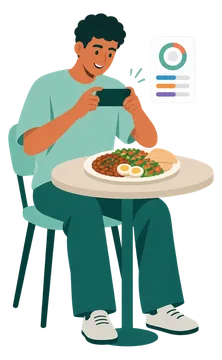
Fitlyn sets a daily protein target with your calories and shows how much you have eaten after each meal. The barcode scanner and food search make it quick to see which of your usual foods carry the most protein.
Sources
- Jäger R, et al. International Society of Sports Nutrition position stand: protein and exercise. Journal of the International Society of Sports Nutrition, 2017.
- Institute of Medicine. Dietary Reference Intakes for Energy, Carbohydrate, Fiber, Fat, Fatty Acids, Cholesterol, Protein, and Amino Acids, 2005.
- Bauer J, et al. Evidence-based recommendations for optimal dietary protein intake in older people (PROT-AGE Study Group). JAMDA, 2013.